Great Britain Has 14 Distribution Licence Areas, 6 Flexibility Markets and 5 Owners
- Triple Edge Energy
- Energy Markets , Flexibility Services
- 24 Aug, 2026
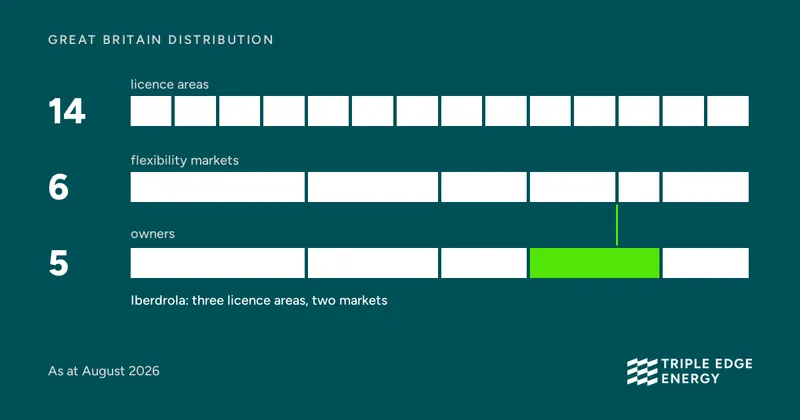
Great Britain has 14 electricity distribution licence areas, held by six licence groups, under five ultimate owners. Note acronyms and glossary table at the end for reference.
These don’t neatly line up and organise - which one governs depends on what we/you are trying to do:
- The licence area is the regulatory unit. Fourteen of them. Each carries its own licence conditions and its own price control settlement. This is the unit Ofgem regulates.
- The market is the commercial unit. Six of them. Every licence group runs a single flexibility procurement across all of its areas - National Grid Electricity Distribution tenders its four areas as one market, UK Power Networks its three as a single competition, SSEN its two.
- The owner is the corporate unit. Five of them, after ENGIE completed its acquisition of UK Power Networks on 7 May 2026.
The slightly confusing part is what happens when those units cross. Iberdrola owns three of the fourteen licence areas - but reaches them through two separate markets, because SP Energy Networks and SP Electricity North West remain separate network businesses with separate licences, separate portals, separate tender calendars and separate qualification. UK Power Networks also holds three licence areas, and reaches them through one.
What the operator is actually buying
Distribution flexibility is procured locally and specifically. An operator does not buy “flexibility” in the abstract - it buys a defined response, in a defined zone, in a defined window, because a particular transformer or feeder is forecast to exceed its limit.
Payment typically has two parts: availability, for being contracted and ready across a service window, and utilisation, for energy response actually delivered when instructed. Requirements are published per tender round, and both the volume sought and the price vary by zone, because the underlying constraint does.
That is why location is key in this market. A capable asset in an unconstrained area has nothing to sell to its local network operator (however, depending on scale, may be able to service wider network energy markets). The same asset a few miles away, behind a constrained primary substation - the substation that feeds a town or an industrial district - may have a live requirement against it.
Finding your own network operator
A site bill information gives what is needed, not just a postcode lookup.
Every GB supply point has an MPAN, printed in a box and sometimes labelled “supply number”. The box has two rows, 21 digits in total. The distributor is identified by the first two digits of the bottom row - the 13-digit number. Counting across the whole 21 digits, that is digits 9 and 10, which is how the Energy Networks Association describes it. If you get a number below 10, you have read the top row - that is the profile class, which identifies your metering arrangement and not your network.
Numbers 10 to 23 are the 14 licence areas below. 24 or higher means you are connected to an independent network - which changes how you identify your host operator, not whether being on an IDNO rules you out. That case is covered further down.
The same areas are also called GSP groups, lettered _A to _P with no _I or _O, and historically PES regions. The letter appears in settlement data and most charging statements; the number appears on the bill.
The 14 licence areas
| MPAN | GSP | Licence area | Operating brand | Ultimate owner | Broadly covers (indicative - your MPAN is definitive) |
|---|---|---|---|---|---|
| 10 | _A | Eastern England | UK Power Networks | ENGIE | Essex, Suffolk, Norfolk, Cambs, Herts, Beds |
| 11 | _B | East Midlands | NGED | National Grid plc | Notts, Derbys, Leics, Lincolnshire, Northants |
| 12 | _C | London | UK Power Networks | ENGIE | Greater London |
| 13 | _D | Merseyside & North Wales | SP Energy Networks (SP Manweb) | Iberdrola | Merseyside, Cheshire, north Wales, Shropshire |
| 14 | _E | West Midlands | NGED | National Grid plc | Birmingham, Black Country, Coventry, Staffs, Warks, Worcs, Shropshire |
| 15 | _F | North East England | Northern Powergrid | Berkshire Hathaway Energy | Tyne & Wear, Durham, Northumberland, Teesside |
| 16 | _G | North West England | SP Electricity North West (formerly Electricity North West) | Iberdrola | Cumbria, Lancashire, Greater Manchester |
| 17 | _P | North Scotland | SSEN | SSE plc | Scotland north of the central belt, Highlands & Islands |
| 18 | _N | South & Central Scotland | SP Energy Networks (SP Distribution) | Iberdrola | Central belt, Ayrshire, Borders, Dumfries & Galloway |
| 19 | _J | South East England | UK Power Networks | ENGIE | Kent, Sussex, Surrey |
| 20 | _H | Southern England | SSEN | SSE plc | Thames Valley, Hants, Dorset, Wilts, Oxon, Berks, Isle of Wight |
| 21 | _K | South Wales | NGED | National Grid plc | South and mid Wales |
| 22 | _L | South West England | NGED | National Grid plc | Cornwall, Devon, Somerset, Bristol, Glos |
| 23 | _M | Yorkshire | Northern Powergrid | Berkshire Hathaway Energy | North, West, South and East Yorkshire, Lincolnshire |
Some counties appear in two rows: Licence boundaries follow the network as it was built, not county lines - several of them trace back to the 1948 municipal undertakings. Shropshire and Lincolnshire are each split between two operators. Warrington, Crewe and Chester, for instance, sit with SP Manweb rather than with the North West operator.
Which is the point of the column being marked indicative. Use it to orient; use your MPAN to decide.
Areas per group: NGED four, UK Power Networks three, SSEN two, SP Energy Networks two, Northern Powergrid two, SP Electricity North West one.
What changed, and when
Several circulated versions of this table predate the following:
- Western Power Distribution became National Grid Electricity Distribution - acquisition completed June 2021, rebrand 2022. Write NGED rather than “National Grid” unqualified; the latter now reads as the transmission business, which is a different business in the same group.
- Iberdrola acquired 88% of Electricity North West in October 2024 (a Japanese-led consortium holds the remaining 12%), and the business rebranded to SP Electricity North West on 5 August 2025. The licensed entity did not change.
- ENGIE completed its acquisition of UK Power Networks on 7 May 2026, buying 100% from its CK group owners.
Ownership keeps moving because of how these networks are paid, not for any reason specific to one operator. A distribution licence earns a regulated return on its asset value, and that value is index-linked and growing as networks fund the investment the electrification transition requires. That combination is why ownership has changed hands more than once in the last few years - and why it is worth checking before relying on it rather than assuming it is settled.
If your MPAN starts with 24 or higher
Independent Distribution Network Operators hold distribution licences that are not geographically restricted. They typically own the “last mile” - the network built to serve a new business park, industrial estate or data centre - connected into the incumbent operator’s network at a defined point of connection. Their distributor IDs run from about 24 upwards.
If your site is on a modern industrial estate, your MPAN may not appear in the table above. However, you are not outside the grid system.
An IDNO-connected asset can provide flexibility to the host network operator, subject to where it sits electrically. Asked directly whether an IDNO-connected asset can participate, NGED answers: “Yes, but the point of connection between the IDNO Networks and the DNO network must be within the defined boundary of the same Constraint Management Zone (CMZ).” That wording is NGED’s; other operators publish the condition differently or not at all, so we can check the one you are in.
Some detail behind that condition: take a thermal constraint first - a primary transformer or an HV feeder forecast to exceed its rating. If the IDNO’s point of connection sits downstream of that asset, everything on the IDNO network sits downstream too, and a load reduction there shows up as reduced current in the constrained asset. It is physically valid flexibility. But if the point of connection is fed from a different primary, it does not relieve that constraint at all - regardless of how close the site looks on a map.
Which leads to a practical point: eligibility is validated per MPAN, not per postcode. Appearing inside a postcode listed in a tender dataset is a screening signal, not qualification - the MPAN has to be confirmed as electrically connected to the zone, and two units on the same estate can differ. For an IDNO-connected site there is a further step, because the test applies to the IDNO’s point of connection, which your own MPAN does not locate for the host operator.
The same logic governs aggregation. Minimum participation sizes have fallen a long way - 10 kW minimums are now common, and both UK Power Networks and SP Electricity North West sit there - and smaller assets can be aggregated to reach them. But aggregation works within a constraint management zone, not across zones. You cannot combine a site in one zone with a site in another to reach a locational product’s minimum, because the product is locational.
DNO, DSO and NESO are different things
| Term | What it is |
|---|---|
| The DNO | The licensed owner-operator of the local network - the wires, transformers and substations, and who you contact about a connection. |
| The DSO | A role, not a separate company: the active management of that network, forecasting constraints and procuring flexibility as an alternative to building more network. |
| NESO | The National Energy System Operator. Publicly owned since 1 October 2024, having been acquired from National Grid. It operates the national transmission-level system and procures national services. |
Under RIIO-ED2, the price control running 1 April 2023 to 31 March 2028, Ofgem placed DSO obligations on every distribution licensee and required the DSO function to be governed separately from the DNO function. That is a governance separation, not a legal one - the same company, obliged to make those decisions at arm’s length from itself. RIIO-ED3 starts 1 April 2028.
The NESO change was one of ownership and remit rather than a rebrand: under the Energy Act 2023 it also took on gas system planning, so “National Grid ESO” no longer exists.
The two used to divide cleanly along national-versus-local lines. That is no longer quite true. Under service terms effective 9 April 2026, NESO’s Demand Flexibility Service procures zonally, with a 0.1 MW threshold, so NESO now buys with geographic granularity too. It also buys in both directions, though for a different reason than a DNO does - national supply rather than a local limit. A site can serve both. Which instruction takes precedence when they conflict, and what that does to the value of each, needs its own piece.
One change most GB explainers have not caught up with (that we could find): the ENA concluded its Open Networks programme in July 2025, after eight years, and Elexon took on the Market Facilitator role for distributed flexibility in December 2025, publishing a catalogue of active flexibility sub-markets in March 2026. ENA documents have not been superseded as far as we could establish - the ENA Standard Agreement for Flexibility Services v3.0 (April 2024) remains the contractual basis - but the programme that produced them has closed.
Where to check, rather than a table
The platform each operator tenders on moves, and it has moved a bit recently. Electron has taken over tendering at three of the six groups since 2024 - SP Electricity North West and SSEN during 2024, and SP Energy Networks on 31 March 2026, migrating from Piclo. Any platform guidance written before 2024 may need to be checked again.
There are some other nuances more specific than “the platform moved”. A single operator can run you across three different systems, and they are not the same system. NGED is the clearest illustration: registration, qualification and contract acceptance happen on its Market Gateway; requirements are published to Flexible Power and its Connected Data Portal; and dispatch, delivery and settlement happen on the Flexible Power Portal.
So seeing a requirement in one place does not tell you where to bid, and being registered in one place does not mean you are set up to be dispatched. Flexible Power is a joint initiative of four operators - NGED, Northern Powergrid, SSEN and SP Energy Networks - and two of those four now run their live tendering on ElectronConnect while still publishing requirements to Flexible Power. Work out which system does which job for your operator before assuming any of them is the whole picture.
That is why this article does not carry a platform table. What is worth checking instead:
- Elexon’s flexibility market catalogue - a single published view of the active flexibility sub-markets, showing how each works, who buys, and how providers are paid.
- Your operator’s own flexibility pages - constraint zone maps, tender calendar, and the platform it is actually using this round. The only thing worth trusting on the day.
- The ENA’s network operator lookup - postcode to operator, if you would rather not find your MPAN.
- NESO’s GIS boundaries for the GB licence areas - the areas themselves, in GeoJSON, shapefile or print formats.
- Ofgem’s licensee list - the definitive record of who holds which licence, including every IDNO.
The authoritative register for MPAN distributor IDs is Elexon’s Market Domain Data, maintained under BSC Procedure BSCP509. It is distributed to market participants as a data flow rather than published as a lookup page, which is a large part of why comparison sites dominate the search results for this question.
Northern Ireland and Ireland are not GB
The network operator map that circulates most widely carries eight logos, which is one reason the counts get muddled. It shows the membership of a trade body covering Ireland as well as the UK, not the licence areas of Great Britain.
Northern Ireland Electricity Networks operates a separate jurisdiction under the Utility Regulator. ESB Networks operates the Republic of Ireland under the CRU. Neither is a GB distribution licence area, and neither participates in the arrangements described here.
The structural contrast is worth noting for anyone working across both: Ireland has a single distribution system operator, so there is one distribution counterparty rather than six.
Triple Edge Energy helps assess revenue stacking and optimisation for sites like these. If you are working out what a particular connection can sell, and to whom, that is where we would start.
Acronyms and glossary
| Term | What it means |
|---|---|
| Availability payment | Paid for being contracted and ready across a service window, whether or not you are instructed. Normally subject to testing, so it means ready and provably ready, not just signed up. |
| CMZ | Constraint Management Zone, also written Constraint Managed Zone. The area a network operator draws around a specific constraint; products are bought per zone. A shared industry term from the Flexible Power standard products, used by NGED, UK Power Networks and SSEN among others - not one operator’s coinage. |
| DFS | Demand Flexibility Service. NESO’s demand-side service. Since April 2026 it has procured zonally as well as nationally, dropped its threshold to 0.1 MW, and paid for turning demand up as well as down - the turn-up being for national oversupply, not for any local network constraint. |
| DNO | Distribution Network Operator. The licensed owner-operator of the local network, and who you contact about a connection. |
| DSO | Distribution System Operator. A role rather than a company: actively managing the network and buying flexibility instead of building more of it. Governed separately from the DNO function inside the same business. |
| Elexon | Administers the Balancing and Settlement Code, and since December 2025 the Market Facilitator for distributed flexibility. |
| ENA | Energy Networks Association. Trade body for network operators across the UK and Ireland. Publishes the Standard Agreement for Flexibility Services. |
| GSP group | Grid Supply Point group. The settlement region a supply point sits in, lettered _A to _P with no _I or _O. One per licence area and normally the same ground, but it is a settlement attribute carried on the meter point rather than a licensed boundary - NESO’s GSP dataset records exceptions where a network serves demand across a licence-area boundary. |
| HV (GB usage) | 6.6 kV and 11 kV, the voltage of the feeders leaving a primary substation. 22 kV and above is EHV. This differs from Ireland: ESB Networks calls 10/20 kV MV and reserves HV for 38 kV and up, so a GB “HV feeder” is an Irish “MV feeder”. |
| IDNO | Independent Distribution Network Operator. Holds a distribution licence that is not geographically restricted, and typically owns the last-mile network on a new estate or business park, connected into the host operator’s network at a defined point of connection. Distributor IDs run from about 24 up. |
| MPAN | Meter Point Administration Number. The 13-digit bottom row, the core, identifies a GB supply point; the 8-digit top row adds profile and loss data, making 21 digits in all. The distributor is the first two digits of the core - digits 9 and 10 of the 21. Ireland’s equivalent is the MPRN. |
| NESO | National Energy System Operator. Publicly owned since 1 October 2024. Runs the national transmission-level system and buys national services. |
| Ofgem | The GB energy regulator. Issues distribution licences and sets the price control. |
| PES region | Public Electricity Supplier region. The older name for the same 14 areas, from when one company both distributed and supplied in each: twelve regional companies in England and Wales plus two in Scotland, privatised under the Electricity Act 1989. The Utilities Act 2000 split distribution from supply in 2001, which is when DNOs became separate from suppliers. Still appears in legacy documents. |
| Primary | Primary substation. Steps sub-transmission voltage down to the HV distribution voltage, usually 33 kV to 11 kV, though 66 kV and 132 kV inputs and 6.6 kV outputs all exist. Most procured distribution constraints are defined at this level or the one above it. It is the relevant boundary for whether flexibility helps because it is the last point with continuous telemetry and the point below which the network runs radially - not because of the voltages. |
| RIIO-ED2 | The second electricity distribution price control under Ofgem’s RIIO framework (Revenue = Incentives + Innovation + Outputs). 1 April 2023 to 31 March 2028. Placed the DSO obligation on every distribution licensee and required the DSO function to be governed separately from the DNO function. |
| RIIO-ED3 | The next electricity distribution price control. Starts 1 April 2028. |
| Utilisation payment | Paid for energy actually delivered when instructed. Unlike availability, it cannot be forecast reliably, because it depends on how often the operator calls. |
References
Structure and licensing
- Energy Networks Association, Who’s my network operator? - postcode lookup, and the “digits 9 and 10 of the 21-digit MPAN” formulation.
- National Energy System Operator, GIS Boundaries for GB DNO Licence Areas - dataset updated 3 May 2024. The source for 14 licence areas, and for NGED holding four of them.
- Ofgem, List of all electricity licensees including suppliers - current version 28 May 2026.
- Elexon, Market Domain Data and BSCP509: Changes to Market Domain Data - the authoritative register for distributor IDs and GSP groups.
Ownership
- London Power Networks plc, RNS, 7 May 2026, Sale of UK Power Networks Holdings Ltd - completion of the ENGIE acquisition.
- UK Power Networks, ENGIE announces the acquisition of UK Power Networks (announced 25 February 2026); ENGIE UK power distribution.
- ScottishPower, New look for SP Electricity North West, August 2025; SP Electricity North West newsroom.
Regulation and system operation
- Ofgem, Electricity distribution price control 2023 to 2028 (RIIO-ED2).
- Ofgem, Decision notice to establish the National Energy System Operator - NESO from 1 October 2024.
- NESO, Demand Flexibility Service - service terms and procurement rules effective 9 April 2026, including zonal procurement and the 0.1 MW threshold.
- Energy Networks Association, Open Networks - programme concluded July 2025.
- Elexon, Market facilitator for distributed flexibility (from December 2025) and Elexon launches flexibility market catalogue (March 2026).
Flexibility markets and platforms
- National Grid Electricity Distribution DSO, Further information - the IDNO point-of-connection condition, quoted verbatim, and the platform split between Market Gateway and the Flexible Power Portal.
- Flexible Power - joint initiative of NGED, Northern Powergrid, SSEN and SP Energy Networks; the four-operator requirements statement.
- SP Energy Networks, SP Energy Networks have launched new flexibility platform ‘Electron’ - all flexibility tendering via ElectronConnect from 31 March 2026.
- Energy Networks Association, Standard Agreement for Flexibility Services v3.0, April 2024.